A quick visit to a supermarket or retail store rarely feels risky. Most people walk through the doors expecting clean aisles, secure shelving, and safe walkways. Unfortunately, accidents happen more often than many realise. A spilled drink left unattended, a loose entrance mat, or merchandise stacked carelessly can cause serious injuries in seconds. A quick visit to a retail store rarely feels risky, but accidents happen more often than many realise. If you are injured, pursuing supermarket injury claims can help cover your rehabilitation, medical costs, or months of recovery.
When an injury in a public place occurs because a business has not properly managed hazards on its premises, the injured person may have the right to pursue a public liability compensation claim. These claims are designed to compensate individuals who have suffered financial, physical, and emotional losses due to another party’s negligence.
Commercial properties that welcome customers onto their premises owe visitors a legal duty of care. That duty includes regularly inspecting the property, identifying potential hazards, repairing dangerous conditions where practical, warning customers about temporary risks, and maintaining reasonable safety procedures. Businesses are not expected to prevent every accident, but they are expected to respond appropriately when foreseeable dangers arise.
Successfully proving a public liability compensation claim requires much more than showing that an accident happened. The evidence must demonstrate that the business knew or should reasonably have known about the hazard and failed to deal with it appropriately. This guide explains the most common causes of supermarket injuries, outlines the public liability claim process, and explains why professional legal guidance can make a significant difference when pursuing compensation.
Common Supermarket Injury Claims: Hazards That Lead to Public Liability Compensation
Supermarkets and retail stores are busy environments where hundreds or even thousands of customers may enter each day. Constant foot traffic, product deliveries, cleaning activities, and restocking create situations where hazards can develop quickly if proper safety procedures are not followed.
Liquid Spills Can Cause a Slip and Fall Accident and a Public Liability Compensation Claim
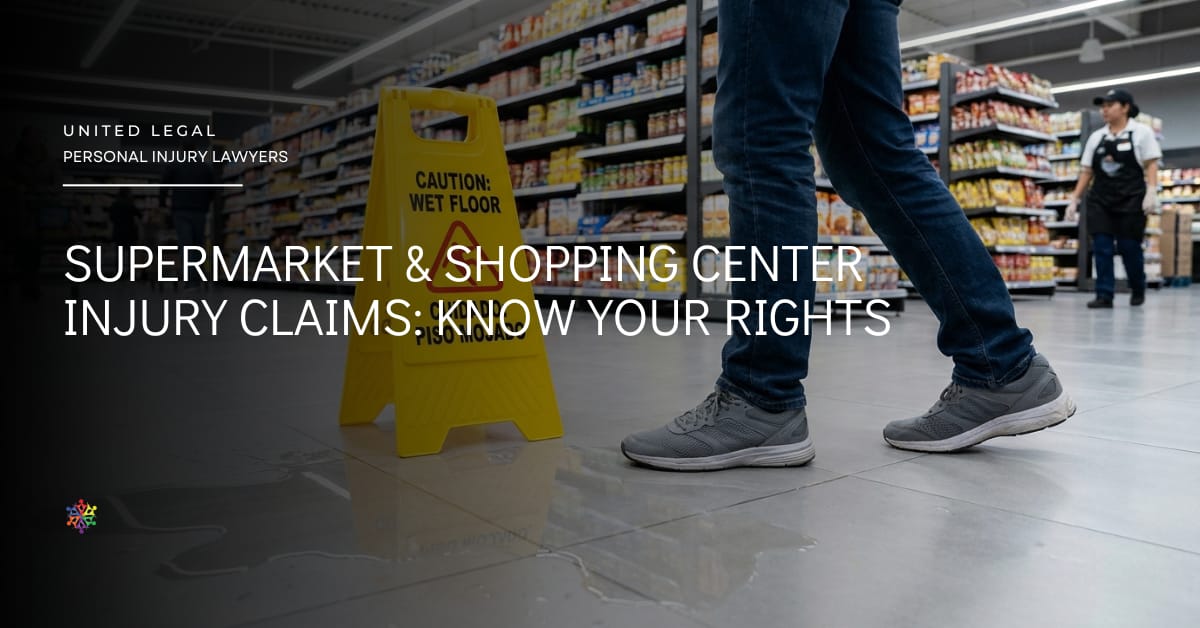
A slip and fall accident is one of the most common incidents leading to a public liability compensation claim. Spilled drinks, leaking refrigeration units, broken bottles, or food products left on the floor create obvious slipping hazards.
The existence of a spill alone does not automatically establish negligence. The key legal question is whether the spill remained on the floor long enough that staff should reasonably have discovered and cleaned it, or whether appropriate warning signs should have been placed around the affected area until it was safe.
Inspection records, CCTV footage, and witness statements often become valuable evidence when determining how long the hazard existed before the accident occurred.
Freshly Mopped Floors and Supermarket Injury Claims
Cleaning is necessary to maintain hygiene, but freshly mopped floors become hazardous when warning signs are missing or positioned where customers cannot easily see them.
A customer walking around a corner may have little opportunity to notice the slippery surface before falling. Businesses should ensure temporary hazards created during routine cleaning are clearly identified until the floor becomes safe again.
Faulty Automatic Doors and Entrance Hazards
Entrance areas receive constant traffic throughout the day. Automatic doors that malfunction, uneven thresholds, damaged flooring, or rainwater tracked inside can all increase the likelihood of an injury in a public place.
Because entrances are predictable high-risk areas, businesses are generally expected to inspect them frequently, particularly during poor weather conditions.
Faulty Automatic Doors in Supermarket Injury Claims
Retail shelves should be stocked carefully to prevent products from falling onto customers.
Heavy boxes placed above shoulder height, unstable displays, or overloaded shelving can result in serious injuries if merchandise falls unexpectedly. Head injuries, shoulder injuries, and fractures are common in these circumstances.
Evidence showing poor stocking practices or previous complaints about unstable shelving may strengthen a public liability compensation claim.
Floor Hazards Behind Many Supermarket Injury Claims
Floor mats are intended to improve safety, yet damaged or curled mats often become tripping hazards themselves.
Similarly, cracked tiles, worn carpets, uneven flooring, or potholes in outdoor walkways can easily cause customers to lose their footing.
Routine maintenance programs should identify these defects before they create unnecessary risks for visitors.
Dim Lighting in Parking Lots and Walkways
Poor lighting affects visibility and makes it difficult for customers to identify changes in floor level, kerbs, obstacles, or damaged pavement.
If inadequate lighting contributes to a customer’s injuries, evidence showing that lighting maintenance had been neglected may become relevant when establishing liability.
Every hazard is different, but one principle remains consistent: the stronger the evidence demonstrating how the hazard developed and how long it remained unaddressed, the stronger the foundation of a public liability compensation claim.
The Step-by-Step Supermarket Injury Claims Process
The public liability claim process begins immediately after the accident. Many people understandably focus only on their injuries, yet the actions taken in the first few hours can significantly affect the outcome of a future claim.
Prioritise Your Safety and Seek Medical Treatment
Your health always comes first.
Even if you believe your injuries are minor, obtain medical attention as soon as possible. Conditions such as concussion, internal injuries, ligament damage, and spinal injuries may not become obvious immediately.
Prompt medical treatment creates an independent medical record linking your injuries directly to the incident.
Report the Incident to Store Management
Notify the store manager before leaving whenever possible.
Ask for the incident to be formally recorded and check that important details such as the location, time, and nature of the accident have been accurately documented.
An official incident report often becomes important evidence later.
Photograph the Hazard for Supermarket Injury Claims
If you are physically able, use your phone to photograph:
- The exact hazard
- The surrounding area
- Missing warning signs
- Lighting conditions
- Your visible injuries
Photographs taken immediately after an accident often provide stronger evidence than descriptions recorded weeks later.
Request Preservation of CCTV Footage
Many supermarkets operate extensive CCTV systems.
Security footage may reveal:
- The condition of the hazard
- Staff inspections
- Previous customers avoiding the area
- How the accident occurred
Because surveillance footage may only be retained for a limited period, requesting that it be preserved promptly is an important step in the public liability claim process.
Obtain Witness Details
Independent witnesses can provide valuable evidence if liability is disputed.
Ask witnesses for:
- Full name
- Telephone number
- Email address
Their statements may confirm facts that are difficult to establish using photographs alone.
Keep Detailed Financial Records
A public liability compensation claim may include more than immediate medical costs.
Maintain copies of:
- Medical invoices
- Prescription costs
- Physiotherapy expenses
- Travel costs
- Lost wages
- Care and assistance expenses
Accurate documentation helps demonstrate the financial impact of the injury.
Learn more about the strict [time limits for filing a compensation claim]
How to Prove Supermarket Injury Claims: Why Legal Evidence Matters
One of the most difficult aspects of any public liability compensation claim is proving negligence.
The law generally requires evidence that the business owed a duty of care, a foreseeable risk existed, appropriate action was not taken within a reasonable timeframe, and that failure directly caused the injury.
Businesses and their insurers often investigate these issues carefully before accepting responsibility.
Proving the Risk Was Foreseeable
Not every accident results from negligence.
A successful claim often depends on showing that the dangerous condition was reasonably foreseeable and that practical steps could have reduced or eliminated the risk.
Inspection schedules, cleaning logs, maintenance records, and previous complaints may all assist in proving this element.
Dealing With Corporate Insurance Adjusters
Insurance representatives frequently examine every aspect of an accident.
They may argue that:
- The customer was distracted.
- Appropriate warning signs were displayed.
- The hazard appeared only moments before the accident.
- The injuries are unrelated to the incident.
These arguments can significantly affect the outcome of a claim if they are not properly addressed with evidence.
Time needed: 5 minutes
How a Public Liability Lawyer Strengthens Supermarket Injury Claims
- An experienced public liability lawyer understands how evidence should be gathered, preserved, and presented.
Investigating the accident
- Obtaining CCTV footage
- Reviewing maintenance records
- Obtaining expert medical opinions
- Calculating future financial losses
- Negotiating directly with insurers
Strong legal preparation often encourages insurers to resolve claims more efficiently because the supporting evidence has already been thoroughly assembled.
A lawyer also evaluates whether early settlement offers genuinely reflect the long-term consequences of the injury. Some injuries continue to affect earning capacity, mobility, or quality of life long after initial treatment has ended.
Read our comprehensive guide on how No-Win-No-Fee compensation claims work.
Frequently Asked Questions
You may be able to if your injury resulted from negligence and the available evidence supports your claim.
Medical records, photographs, CCTV footage, witness statements, incident reports, and proof of financial losses all strengthen a public liability compensation claim.
Every public liability claim process is different. The timeframe depends on factors such as liability disputes, the seriousness of the injuries, and ongoing medical treatment.
Yes. An experienced public liability lawyer can assess whether the proposed settlement properly reflects your current and future losses before you make a final decision.
Conclusion
An unexpected accident while shopping can affect far more than your physical health. Medical expenses, time away from work, rehabilitation, and uncertainty about the future can place considerable pressure on both you and your family. Understanding your legal rights is the first step toward protecting your interests.
If you have suffered an injury in a public place, gathering evidence early and understanding the public liability claim process can significantly improve the strength of your public liability compensation claim. Every photograph, medical report, witness statement, and document contributes to building a clearer picture of what happened and why it occurred.
Seeking advice from an experienced public liability lawyer can provide valuable guidance throughout the claims process, helping you navigate legal complexities while focusing on your recovery.